Bloom's Taxonomy
In the class Adolescent Development, I have found myself turning more and more often to Bloom's Taxonomy in developing lesson plans. "In 1956, Benjamin Bloom with collaborators Max Englehart, Edward Furst, Walter Hill, and David Krathwohl published a framework for categorizing educational goals: Taxonomy of Educational Objectives. Familiarly known as Bloom’s Taxonomy, this framework has been applied by generations of K-12 teachers and college instructors in their teaching," (Armstrong). Bloom's Taxonomy is a set of six cognitive processes, which encompass the spectrum of how individuals demonstrate knowledge. The taxonomy categorizes the ways in which learned material can be assessed through observable action. This makes the theoretical work behind Bloom's Taxonomy extremely useful for educators. At this stage in my eduction, I have been referencing the graphic below regularly to guide my development of lesson objectives. To avoid producing immeasurable instructional goals, grounding my lesson planning in the vocabulary of Bloom's Taxonomy will hopefully lend well to useful and quantifiable post-lesson assessment. Regardless, Bloom's Taxonomy is a tool I will continue to use as I develop my teaching skills.
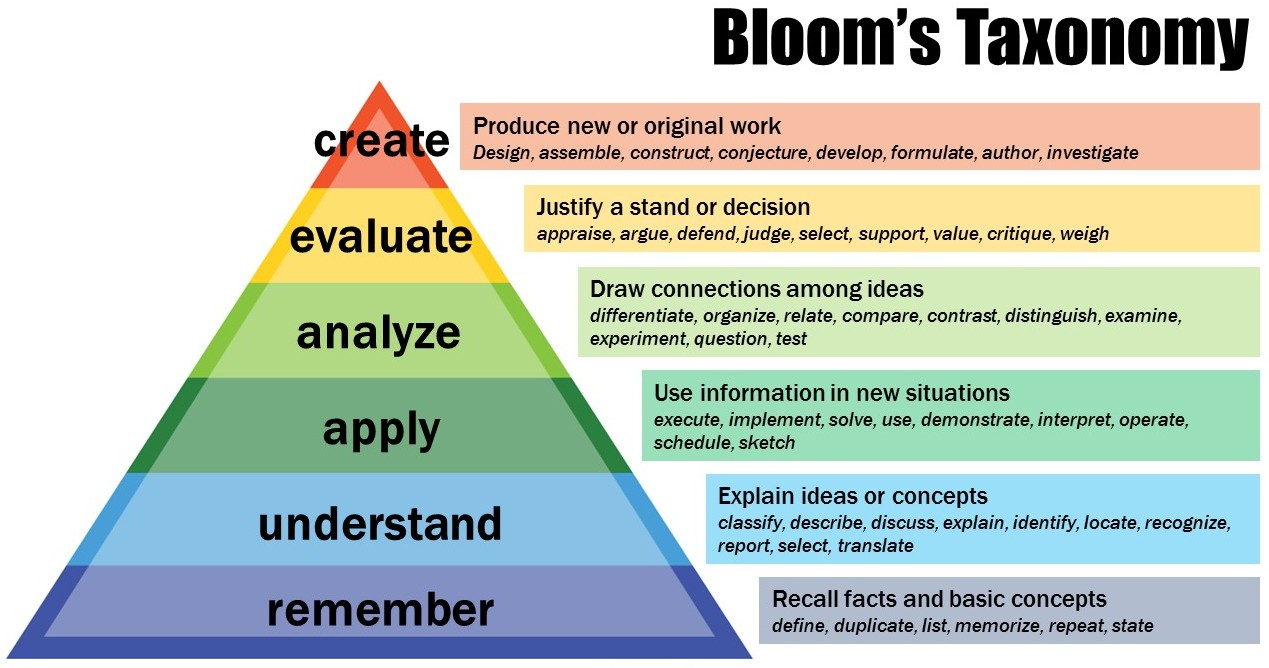
Armstrong, Patricia. "Bloom’s Taxonomy | Center for Teaching | Vanderbilt University." Web. 6 Oct. 2016.
Armstrong, Patricia. "Bloom’s Taxonomy | Center for Teaching | Vanderbilt University." Web. 6 Oct. 2016.
Comments
Post a Comment